
By staff - Central Única dos Trabalhadores, March 2021
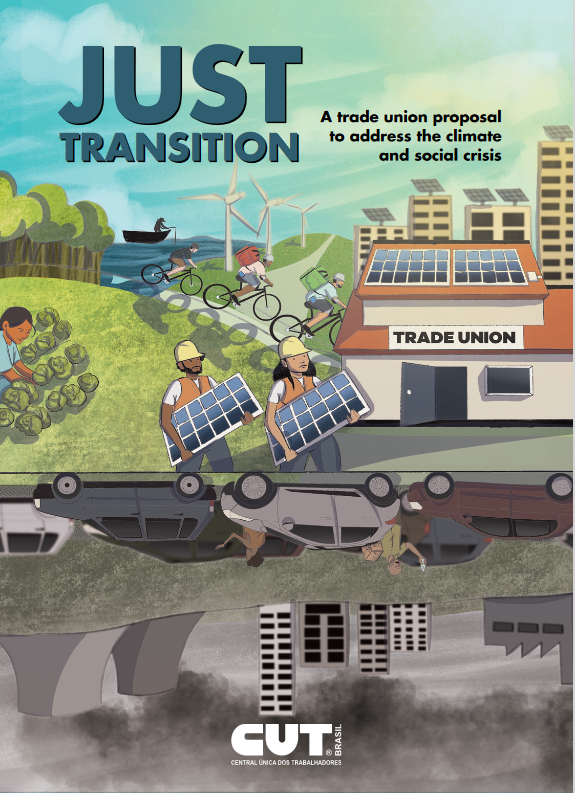 The defense of a trade unionism that fights for a fairer model of society for workers has always been a principle that guided the debates and actions of CUT Brasil. Over the years, the unionism of CUT-Brasil has understood that the defense of the environment and of a model of sustainable development is in the interest of the working class and this topic has become an issue of growing importance. The 13th CONCUT (National Congress of the CUT-Brasil) approved in its resolutions the defense of a just transition, advancing even further in the debate and struggle for a model of society that avoids the climate and environmental crisis and guarantees jobs and rights for the working class.
The booklet “Just Transition: a trade union proposal to address the climate and social crisis” comes at a time when the working class is facing a challenge of containing the unbridled advance of the destruction of the environment and the climate crisis, while defending democracy and its rights against attacks by capital and the extreme right. As the result of a partnership with the International Trade Union Confederation (ITUC), the booklet aims to identify the main specificities of the just transition agenda for CUT-Brasil and the Brazilian working class, in addition to spreading the debate among trade unions, leaders, workers and to strengthen the fight against the production model that exploits the poorest and destroys the environment and our future.
The model imposed by capital causes unemployment, poverty and hunger, at the same time that it destroys entire biomes and threatens to cause permanent damage to the planet, increasing the risks for the working class. For the richest, it is possible to pay for housing, health care and other diverse protections against the problems caused by the climate crisis, such as desertification, floods and pollution. For the working class, avoiding the climate crisis is a necessity for survival.
Although the topic of climate change has many technical terms, in this booklet we seek to use a familiar and accessible language for the entire Brazilian working class.